February 2, 2026
Stop predicting failures in chemicals. Start defining the operating envelope.

Chemical plants don’t lose performance because failures come out of nowhere. They lose performance because high-consequence operating decisions are made without a clear, current understanding of what the plant can actually tolerate.
Predictive maintenance has long promised earlier warnings and fewer breakdowns. But in many chemical operations, it still stops at alerts and health scores—useful signals that arrive without enough context to guide action. Teams are left asking the same questions: Can throughput be increased safely? Can intervention be deferred? Is this deviation harmless, or is it quietly tightening constraints that will matter tomorrow?
The limitation is not prediction.
It is decision clarity.
Treat asset condition as an operating constraint
In chemicals, assets do not degrade in isolation. They degrade based on how they are operated—under specific combinations of temperature, pressure, chemistry, load, and operating mode. Fouling, corrosion, efficiency loss, and wear develop unevenly and often nonlinearly.
Yet many maintenance strategies still treat degradation as a time-based or statistical event.
That approach no longer holds.
Asset condition should be treated as a dynamic operating constraint—one that continuously reshapes how the plant can be run.
In chemical operations, asset condition is not a maintenance signal—it is adynamic operating constraint.
This shift reframes maintenance insight from something to monitor into something that actively defines:
- How close the plant can run to real limits
- Which constraints are tightening due to degradation
- Where safe margin still exists to optimise throughput or energy use
If predictive maintenance cannot answer these questions, it remains informative—but not operational.
Define the operating envelope in real time
What chemical operators ultimately need is not an abstract measure of asset “health,” but a live view of the true operating envelope—the boundaries within which the plant can safely and reliably perform right now.
This means moving beyond static design assumptions. Operating limits evolve as assets age, foul, corrode, and respond to changing process conditions. Over time, envelopes shrink, shift, or become more sensitive to variability.
Predictive maintenance only creates value when it defines what the plant can safely do next.
Reframed this way, predictive maintenance becomes a tool for continuously defining—and defending—the operating envelope, not simply predicting when something might fail.
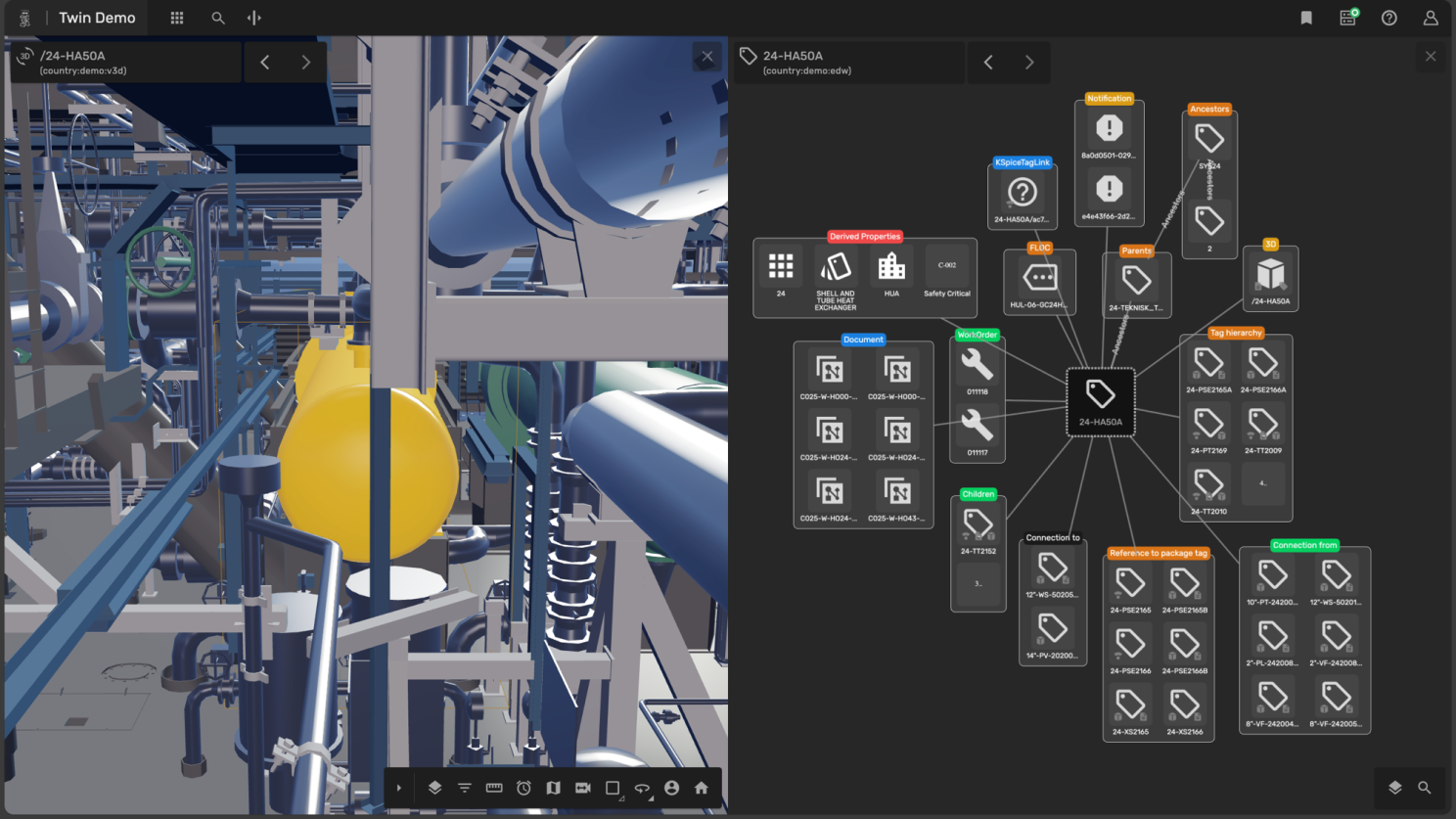 Image showing an example of asset-centric data contextualisation, linking machines to installations and processes, and enriching this hierarchy with signals, dependencies, work orders, risks, constraints, and more.
Use digital twins to test decisions before committing to them
Chemical plants cannot afford to discover whether a decision was safe after it has already been executed.
Digital twins make it possible to evaluate decisions before they are taken—using current operating data combined with engineering-grade models. This allows teams to test real questions they face every day:
- Will increased throughput accelerate degradation or remain within tolerance?
- Does deferring maintenance preserve margin—or quietly increase exposure?
- Is observed variability normal for this operating mode, or a sign of tightening constraints?
Chemical plants don’t need earlier alerts; they need decision-grade clarity about their operating envelope.
This foresight is critical in tightly coupled chemical systems, where small deviations can quickly cascade into safety, quality, or reliability issues.
How Kongsberg Digital enables operating-envelope intelligence
This operating-envelope approach is central to how Kongsberg Digital applies predictive maintenance and digital twins in chemical operations.
Rather than delivering predictive maintenance as a standalone analytics layer, Kongsberg Digital focuses on embedding decision-grade context directly into daily work:
-
Kognitwin® provides a contextualised digital twin that connects asset condition with process state, operating mode, and engineering intent—so degradation is evaluated in context, not isolation
- Engineering-grade simulation, combined with data-driven analytics, explains how operating changes affect asset stress and performance, not just that a change has occurred
- The Industrial Work Surface brings these insights into operational workflows, aligning operators, reliability engineers, and planners around a shared view of reality. The objective is not more dashboards or earlier alarms.
In short, better decisions, made earlier, with greater confidence.
What is success for predictive maintenance in chemicals?
Chemical leaders should stop measuring predictive maintenance success by the number of alerts generated or failures predicted.
The real test is tougher and more operational:
- Did the plant operate closer to its true limits, safely?
- Were interventions timed deliberately rather than reactively?
- Were operations, maintenance, and planning decisions aligned?
When predictive maintenance is implemented as operating-envelope intelligence, value is realised long before failures are avoided—through preserved margin, improved stability, and reduced decision risk.
In chemicals, the organisations that win will be those that treat predictive maintenance as an operating discipline—not a warning system.
Author

Jeff Dietrich
Senior Industry Content Writer, Kongsberg Digital
Related news
May 4, 2026
The energy industry is buying AI, but not scaling it. Here is why.

April 15, 2026
Industrial intelligence is becoming a priority for manufacturing
.png?width=330&height=330&name=Karen-S-blogpost-web%20(1).png)
March 16, 2026
From data to decisions: Key conversations expected at OTC Asia

March 11, 2026
AI and the Future of Drilling: Insights Ahead of OTC Asia