February 8, 2026
India’s Energy System Is Entering Its Execution Decade
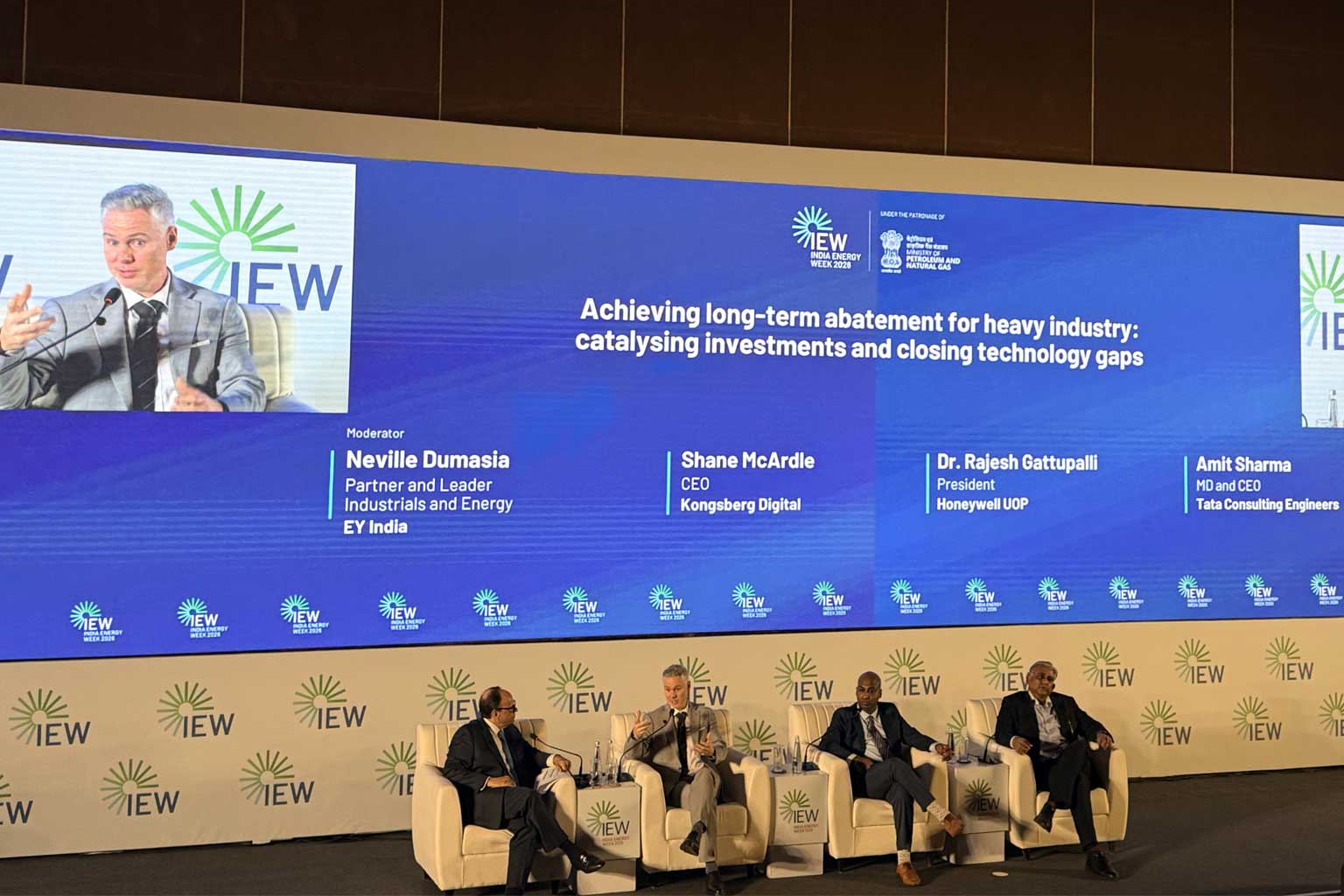
India Energy Week 2026 in Goa highlighted a defining shift in the country’s energy landscape: the transition is moving from long‑term ambition to day‑to‑day execution. Conversations across government, operators, and global partners reflected a shared understanding that India’s energy future will be shaped not only by the scale of new infrastructure but also by how effectively the system performs under real‑world conditions.
The tone was pragmatic. Rather than focusing on declarations or targets, the dialogue centred on resilience, operational readiness, and India’s determination to chart its own pathway in a complex geopolitical environment.
A System Expanding at Unmatched Scale
India enters 2026 with one of the world’s most rapidly evolving energy systems. Electricity demand continues to rise with industrial growth, urbanisation, and electrification. Renewable capacity additions remain among the highest globally. Gas and LNG infrastructure are expanding. Refining and petrochemicals are scaling. Nuclear energy is regaining strategic relevance.
This is not a linear transition. It is a multi‑vector expansion happening simultaneously — and at speed. That complexity is why IEW 2026 focused less on what to build and more on how to operate what is being built.
The Demand of the Hour: Coordination, Flexibility, and Digital Capability
themes that now define India’s energy sector's operational priorities.
1. System‑level coordination
India’s energy system is increasingly interconnected. Decisions in generation, grid operations, fuel logistics, refining, and storage now influence one another in real time. Stakeholders emphasised the need for integrated planning, shared situational awareness, and cross‑value‑chain alignment.
2. Flexibility as a strategic capability
As renewable penetration grows, flexibility becomes essential for maintaining reliability. Gas and LNG were highlighted as stabilising elements — not transitional stopgaps, but deliberate enablers of a high‑renewable grid. Storage, demand response, and regional balancing were also central to the discussion.
3. Digital execution at scale
India’s operators have already invested heavily in digitalisation. The next phase is about operational tools — digital twins, simulation, and AI‑driven decision support — that help teams manage complexity, reduce risk, and improve performance. The focus is shifting from dashboards to connected data, connected models, and connected workflows that support real‑time decision‑making.
These priorities reflect a broader shift: India’s energy transition is becoming an execution challenge rather than just a planning exercise.
India’s Energy Security Story: Quiet Strength and Strategic Independence
A consistent undercurrent at IEW 2026 was India’s evolving role in global geopolitics. The country is navigating a world marked by supply chain realignments, shifting alliances, and heightened competition for resources. Yet India’s approach remains steady: engage widely, depend on no single bloc, and build long‑term resilience at home.
Several factors underpin this confidence:
• Diversified energy sourcing reduces exposure to geopolitical shocks.
• Expanding LNG partnerships strengthens supply security.
• Domestic manufacturing capacity in solar, batteries, and digital infrastructure reduces import dependence.
• A balanced energy mix — renewables, gas, oil, coal, and nuclear — ensures stability during global volatility.
• Clear policy direction provides predictability for investors and partners.
India’s message is consistent: it will collaborate openly, but it will not compromise its strategic autonomy. Its energy pathway will be shaped by national priorities and operational realities.

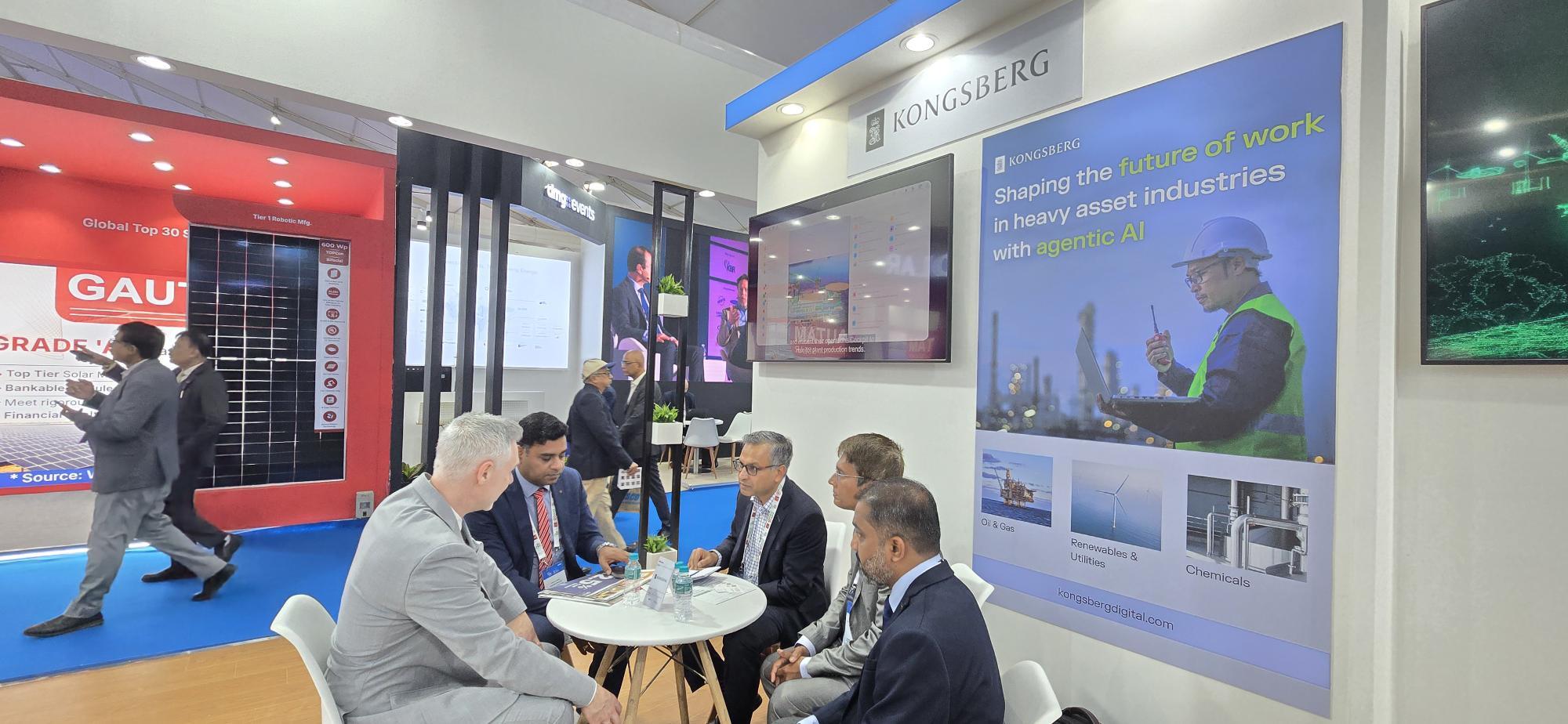
We were pleased to welcome industry peers to conversations at the Norway Pavilion.
Why AI‑Powered Digital Twins Are Becoming Core Infrastructure
For Kongsberg Digital, the conversations at IEW 2026 reaffirmed a clear trend: digital twins are no longer transformation projects — they are becoming core operational infrastructure.
Three reasons stand out:
1. They make the system visible
Digital twins unify real‑time information across assets and networks, giving operators a shared operational picture.
2. They make decisions safer and faster
AI‑driven scenario analysis allows teams to test actions before executing them — reducing risk and improving reliability.
3. They enable coordinated execution
Digital twins connect planning, operations, maintenance, and commercial functions. This is essential in a system where renewable variability, fuel logistics, and industrial demand are increasingly interdependent.
AI and digital twins form the operating fabric of a modern energy system — enabling operators to move from reactive decisions to predictive, model‑driven execution.
India 2030: A System Defined by Performance and Independence
India’s energy transition will not be judged by targets alone. It will be judged by how the system performs — reliably, safely, and sustainably — under real conditions.
IEW 2026 showed that India is preparing for this reality with a blend of pragmatism and confidence. The country is strengthening its energy security, expanding its global partnerships, and building the digital foundations needed for a more complex future.
India is not simply following global trends. It is shaping its own pathway — one rooted in resilience, independence, and operational excellence.
And that is why the world is paying attention.
Author

Siddharth Setia
Siddharth (Sid) Setia is GM APAC for Kongsberg Digital, spearheading Business Growth and Strategy across APAC markets, including Australia, New Zealand, India, and Japan. Bringing more than two decades of industry experience, Sid joined Kongsberg Digital in early 2024, following a distinguished 15+ year tenure with the Fortune 500 Japanese conglomerate. Beyond his role at KDI, Sid contributes as a Board member on Society of Petroleum Engineer’s – Western Australia Chapter (SPE), Norwegian Australian Chamber of Commerce & Industry (NACC) and a Hyper-AI tech start-up focused on subsurface geology. Sid is a Mechanical Engineer (India) and holds a post-grad in Petroleum Engineering from Curtin University, Australia.